The Complete Guide to AI Search Engine Optimization

Search is changing fast. People used to type a few words into Google and click through ten blue links. Now they ask a chatbot a full question and get one answer. That answer often comes with no links at all.
Traditional search results used to be the whole game. Now they are just one piece of a much bigger picture.
Your customers still type search queries into Google, but they also ask AI tools the exact same questions in a more natural, conversational way.

This shift is why ai search engine optimization matters so much right now. If your business only ranks in old-school search results, you might be invisible in the tools people use every day, like ChatGPT, Google AI Overviews, and Perplexity.
At Sparkz Marketing, we have spent the last year testing what actually works in this new world. This guide breaks it all down in plain language.
No fluff. No jargon. Just what you need to know to stay visible.
What Is AI Search Engine Optimization?
AI search engine optimization is the process of making your content easy for AI tools to find, understand, and quote. Think of it as SEO's next chapter.
Traditional SEO focused on ranking pages. AI optimization focuses on getting your brand mentioned inside an AI-generated answer. That could be a ChatGPT response, a Google AI Overview, or a summary from Claude or Gemini.
The goal is the same as always: get found by the right people. The method has changed.
Why AI Search Engines Are Taking Over
More people are skipping traditional search bars. They are asking questions directly to AI search engines and getting instant answers.
A few reasons this is happening:
AI answers save time. No scrolling through pages.
AI tools sound like a helpful friend, not a list of links.
AI Overviews now show up at the top of many Google searches.
Voice assistants and chat apps are built around conversation, not keywords.
This means your content needs to work two ways now. It needs to rank in classic search. It also needs to be pulled into AI answers. That second part is where answer engine optimization comes in.
Answer Engine Optimization: The New Must-Have Skill
Answer engine optimization, or AEO, is about writing content that directly answers a question. AI tools scan the web looking for clear, trustworthy answers to pull from.
Here is the simple version. If someone asks an AI tool "what is the best CRM for small business," the AI wants a short, clear answer it can quote. Pages full of vague marketing talk get skipped. Pages with clear answers get picked.
To win at AEO, structure your content like this:
State the answer early, in one or two sentences.
Follow with supporting details.
Use headers that match real questions people ask.
Keep paragraphs short and easy to scan.
This style also happens to be great for human readers. It is a win on both fronts.
LLM Optimization: Speaking the Language of AI Models
Large language models, or LLMs, are the engines behind tools like ChatGPT and Claude. LLM optimization means shaping your content so these models can read, understand, and trust it.
LLMs learn from massive amounts of training data pulled from across the web. The more your content shows up as a trusted source within that training data, the more likely a model is to recognize and reference your brand.
These models tend to favor content that is:
Clear and well organized
Backed by facts and real sources
Written by someone with real experience
Free of keyword stuffing or spammy tricks
This is where E-E-A-T comes in. E-E-A-T stands for Experience, Expertise, Authoritativeness, and Trustworthiness. Google created this idea years ago, but it matters even more now.
AI models are trained to spot content that feels fake or thin. They favor writers who show real, first-hand knowledge.
If you run a bakery and write about the best flour for sourdough, share what you learned from your own kitchen. That real experience is gold for both readers and AI models.
How to Optimize for ChatGPT and Other AI Tools
Business owners often ask us how to optimize for ChatGPT specifically. The good news is that the same core habits help across most AI search engines.
Here is what actually works:
Write in a natural, conversational tone
ChatGPT and similar tools are trained on how people actually talk. Stiff, robotic writing does not perform as well.
Answer real questions
Think about what your customers actually type or ask out loud. Build content around those exact questions.
Use structured data
Schema markup helps AI tools understand what your page is about. This is a technical SEO step, but it makes a big difference.
Keep your facts current
AI models often pull the most recent, accurate information. Outdated stats or old pricing can hurt your chances of being featured.
Get mentioned elsewhere
AI models often pull from multiple sources to build an answer. If trusted sites, forums, and news outlets mention your brand, you have a better shot at being included.
Chatgpt prompt optimization is also worth understanding, even if you are not building a chatbot yourself. Knowing how people phrase prompts helps you predict what content will get pulled into an answer.
Study the questions your audience is likely typing into these tools. Then build content that answers those exact prompts clearly.
AI Overviews Optimization: Winning the Top Spot on Google
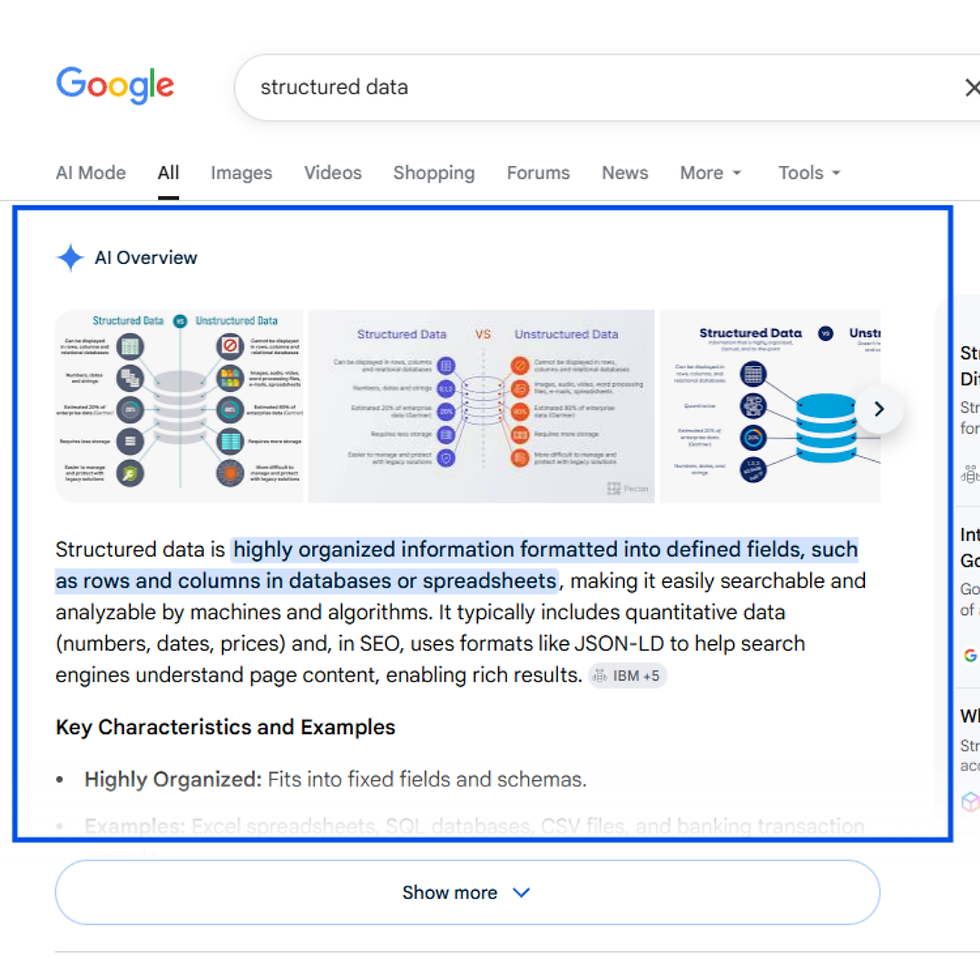
Google AI Overviews are the AI-generated summaries that now appear above regular search results. Getting featured here can mean huge visibility, even if someone never clicks through to your site.
To improve your odds with ai overviews optimization, focus on:
Clear, direct answers near the top of your page
Strong formatting with headers, bullet points, and short paragraphs
Original data or insights that other sites do not have
Fast-loading, mobile-friendly pages
Solid technical SEO, including clean site structure and fast load times
Google's AI Overviews tend to favor pages that are already ranking well organically. So classic SEO and AI optimization are not separate jobs anymore. They work together.
Building an AI SEO Strategy That Actually Works
A strong ai seo strategy blends old and new. The best content strategies do not throw out everything you already know about SEO. They build on it. Here is a simple framework you can follow.
Step 1: Map Out Real Questions
Start with the actual questions your customers ask. Use tools like AnswerThePublic, Google's "People Also Ask," or just your own customer emails and calls.
Step 2: Write Ranch-Style Content
Ranch-style SEO means writing focused, digestible pieces instead of one giant page trying to cover everything. Each piece should answer one clear question really well.
This makes it easier for both readers and AI models to find exactly what they need.
Step 3: Cover Topics In-Depth
Topical relevance matters more than ever. Instead of one blog post about "marketing tips," build a full library of focused posts around each specific topic. This shows real expertise and builds authority in your niche.
Step 4: Earn Genuine Backlinks
High-quality backlinks still matter for both search engines and AI tools. Create content so useful that people naturally want to link to it. Guides, original research, and helpful tools tend to earn links naturally, without any pushy outreach.
Step 5: Optimize for Long-Tail and Semantic Search
Long-tail keywords are longer, more specific phrases. Instead of targeting "marketing," you might target "email marketing tips for small bakeries." These phrases match how people actually search and talk to AI tools.
Semantic search means the search engine understands the meaning behind words, not just the exact match. Write naturally and cover related terms, and you will show up for many more searches than you expect.
AI Visibility: Why It Matters for Every Business
AI visibility is your brand's ability to show up inside AI-generated answers, summaries, and recommendations. This is quickly becoming as important as your position on page one of Google.
Think about it this way. If someone asks an AI assistant "what's a good local coffee roaster," and your business never gets mentioned, you lose that customer before they even see your website.
Boosting your ai visibility takes time, but a few things help speed it up:
Consistent, accurate business information across the web
Reviews on trusted platforms
Mentions in local news, blogs, and directories
An active social media presence that reinforces what your website says
Clear, well-organized website content
AI Content Optimization Tips You Can Use Today
Good ai content optimization does not require a total rewrite of your website. Small, steady changes add up.
Try these steps:
Break long paragraphs into shorter ones
Add clear headers that match search questions
Include real examples from your own business
Update old blog posts with current facts and numbers
Add a short summary near the top of longer articles
These small tweaks make your content easier for both humans and AI tools to digest.
Generative Engine Optimization Services: Do You Need Help?
Generative engine optimization, often shortened to GEO, is becoming a real specialty, separate from traditional SEO.
Generative engine optimization services focus specifically on getting your brand featured in AI-generated answers across tools like ChatGPT, Gemini, and Perplexity.
If your business relies on being found online, this is not something to ignore. It takes ongoing research, testing, and content updates to keep up with how these AI models change over time.
The Future of SEO
The future of SEO is not about picking between traditional search and AI search. It is about doing both well.
Search engines and AI tools will keep evolving. But the core idea stays the same. Create honest, helpful, well-organized content that real experts would be proud of. Do that consistently, and you will stay visible no matter how the technology shifts.
Ready to Get Found in the Age of AI Search?
AI search is not a passing trend. It is already changing how your customers find businesses like yours. The good news is that you do not have to figure this out alone.
At Sparkz Marketing, we help businesses build content and SEO strategies that work across traditional search and AI search engines.
From answer engine optimization to full content overhauls, we build strategies rooted in real experience and real results.


Comments